
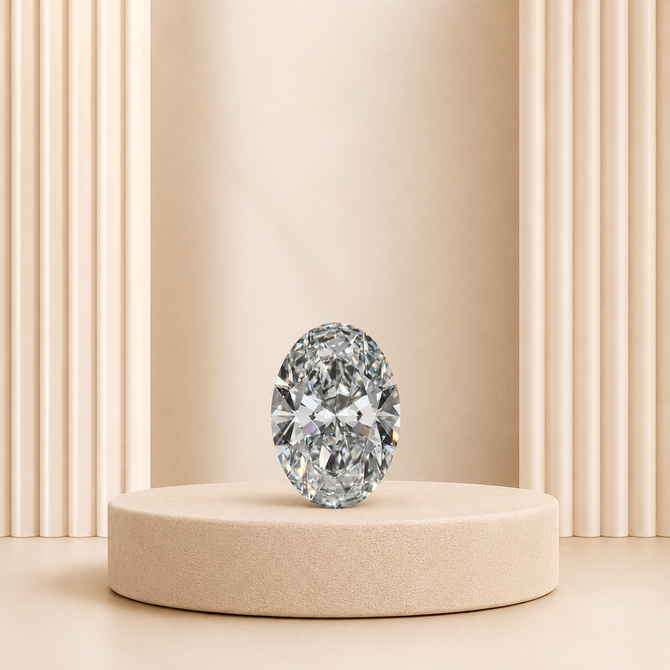
Hearts and Arrows: The Part of Diamond Quality Most People Never Check
Every diamond looks brilliant under a jewelry store display light. That is what those lights are designed to do. They flatter everything and reveal nothing. What they cannot show you is whether that diamond will perform the same way in your kitchen, your office, or any ordinary room where the lighting was not specifically built to make diamonds look good.
Here is what most people never find out: a diamond's cut can be proven. Not estimated. Not assigned a grade between good and excellent. Proven, with a tool that shows you the optical precision of every facet in the diamond.
That tool is a Hearts and Arrows viewer. What it reveals either confirms that a diamond was cut to the highest standard in the world or shows you exactly where the cutter stopped short.
At Grown Diamonds, every precision-cut lab-grown diamond goes through Hearts and Arrows analysis before it reaches you. Not as a talking point. As a standard. Because we grew the diamond and we cut it, and we are not willing to deliver anything that cannot pass what the viewer shows.
Caption: Hearts and Arrows: The Visual Proof of Perfect Cut
The Standard That Started in a Cutting Room in Japan
In the 1980s, a group of Japanese diamond cutters began holding their work to a level of precision the industry had never demanded before. The goal was not a better grade. It was a perfect pattern.
When these diamonds were placed under specialized viewing tools, something appeared that nobody had seen before. Eight perfectly symmetrical arrows from the top. Eight perfectly formed hearts from the bottom. Clean, repeatable, and only possible when every facet landed in exactly the right position.
The Firescope was developed around this discovery. Eightstar was founded. And the diamond world suddenly had a new benchmark, one that could not be argued with because it was visible.
American customers discovered Hearts and Arrows by the 1990s. Once they understood what the pattern meant, they stopped accepting grades as the final word on cut quality. They wanted proof. Precision-cut lab grown diamond jewelry built around this standard became the reference point for anyone serious about what they were buying.
The industry followed. AGS Laboratories and later GIA built more rigorous cut grading systems in direct response to what Hearts and Arrows had proven possible. In 2022, GIA acquired AGSL intellectual property and began issuing AGSL Ideal addendum reports for qualifying diamonds.
A standard that began in a Japanese cutting room four decades ago now defines what the finest certified lab-grown diamonds in the world are measured against. Including every diamond we sell at Grown Diamonds.
Caption: Eight Arrows (Crown View) / Eight Hearts (Pavilion View)
What Separates an Ideal Cut Diamond from a Hearts and Arrows Diamond
Most people assume that an excellent cut grade means a diamond was cut perfectly. It does not.
A cut grade tells you where a diamond's proportions fall on a scale. Get the proportions right and the diamond produces strong light performance. That is what an ideal cut means. It is a proportions story.
Hearts and Arrows is a different story entirely. It is about optical symmetry. Whether every single facet occupies exactly the right three dimensional position relative to every other facet. A diamond can have ideal proportions and still fall well short of true Hearts and Arrows precision. The two things are related but they are not the same.
The Hearts and Arrows pattern only forms within a fairly tight range of proportions. Most of those proportions also happen to produce strong light performance. But achieving ideal proportions without perfect optical symmetry is like building a house with the right materials but slightly off measurements. It holds up. It just never reaches its full potential.
When a diamond gets both right at the same time, ideal proportions and perfect optical symmetry, it earns the title of super ideal cut diamond. That is the category every super ideal cut lab-grown diamond at Grown Diamonds is built around.
GIA Certified Hearts and Arrows diamonds stand at the top of this category. GIA holds the highest authority in diamond grading globally. One thing worth understanding though: when GIA assigns a symmetry grade, it measures meet point symmetry, how well neighboring facets line up at their edges. Hearts and Arrows analysis measures something deeper. How precisely every facet aligns across three dimensional space. A diamond with a GIA excellent symmetry grade may still not display a true Hearts and Arrows pattern. The pattern only appears when 3D optical precision is genuinely there.
At Grown Diamonds, every diamond is evaluated for both. A grade on a certificate is the starting point. The pattern in the viewer is the proof.
What You See When a Diamond Is Truly Perfect
The Hearts and Arrows pattern forms through overlapping facet reflections. Look straight down through the table and you see eight arrows. Flip the diamond and look up through the pavilion and you see eight hearts. Two views. Two patterns. Both reveal the same truth about how precisely that diamond was cut.
Pavilion main facets do most of the work. They drive light return and shape both patterns. The heart pattern is the harder of the two to achieve cleanly. Any small error in cutting shows up there immediately. Uneven heart shapes. Varying sizes. Clefts between the lobes that are too wide or too narrow.
A properly cut Hearts and Arrows lab-grown diamond shows something different. Arrows that line up cleanly. Hearts that are consistent and well formed. Clefts that are tight and even across every heart.
Not every diamond sold as Hearts and Arrows actually meets this standard. Pattern quality varies widely and no universal industry rule enforces the label. What is certain is this: a diamond cannot honestly be called super ideal without near perfect optical symmetry across every facet. At Grown Diamonds, that is not a claim. It is a requirement.
Caption: Acceptable Hearts and Arrows Pattern vs Fails to Meet the Criteria
True Hearts and Arrows vs Near Hearts and Arrows: The Difference You Will Feel
Seeing a diamond once under good lighting does not tell you whether it is truly Hearts and Arrows or just close to it.
The gap between the two becomes clear over time. In different rooms. Under different lighting. In the consistency of how that diamond behaves every single day.
When a diamond achieves exact three dimensional facet alignment, light behaves in a disciplined way. It does not scatter randomly. Brilliance becomes stronger and more consistent. The contrast is sharper. Scintillation fires in a structured pattern rather than appearing in random bursts.
Near Hearts and Arrows diamonds look impressive in a jewelry store. Outside of it, the difference starts to show. The pattern loses its sharpness. The light behavior becomes less predictable. Most people who own one never find out because nobody told them what to look for.
Producing a diamond at true Hearts and Arrows precision costs more. The cutter loses more weight from the rough diamond. The process takes longer. The skill required to hold perfect optical alignment throughout is genuinely rare.
What you get in return is a precision-cut lab-grown diamond that performs at its absolute ceiling from the first day and every day after. That permanence is exactly why people who have owned one never go back to anything less.
Caption: Example of an Ideal Cut with Poor Hearts and Arrows Patterning
What Happens to Light Inside a Perfectly Cut Diamond
Most people judge a diamond by how it looks the moment they first see it. What they are actually responding to, without knowing it, is light performance.
When every facet in a diamond is aligned with exact three dimensional precision, light does not scatter or leak. It returns. Fully, consistently, and in a pattern that the eye reads as brilliance. Brightness improves. Contrast becomes cleaner. Dispersion strengthens. Every quality that makes a diamond worth looking at gets amplified when the cut is genuinely right.
There is also something more instinctive happening. Human eyes are drawn to symmetry. Balanced contrast and structured light behavior register as more beautiful even to people who have no technical understanding of why. Symmetrical scintillation feels comfortable and pleasing. Irregular, chaotic light patterns produce the opposite effect.
This is why a light performance diamond cut to Hearts and Arrows precision stands apart from everything else graded excellent but cut to average tolerances. The grade looks the same on paper. The diamond does not look the same in real life.
At Grown Diamonds, every certified lab-grown diamond in our Hearts and Arrows collection is selected specifically for optical symmetry and verified light performance. Because a diamond that cannot demonstrate what it does in light is not a diamond we are comfortable putting in front of you.
Caption: Virtual Facets, Image Courtesy of AGSL
How to See It for Yourself
The Hearts and Arrows viewer is a simple two part tool. An eyepiece and a black base.
To see the hearts, place the diamond table-down on the flat side of the base. Set the eyepiece on top and look through it. Eight perfectly formed hearts will appear in a properly cut diamond.
To see the arrows, flip the base over. Place the diamond pavilion-down into the conical indentation. Keep the table parallel to the base and perpendicular to your line of sight. Look through the eyepiece. Eight clean, symmetrical arrows in a super ideal cut lab-grown diamond.
One practical thing worth knowing. Once a diamond is set in a ring, the pavilion is no longer accessible. The heart's view requires direct access to the bottom of the diamond. This is why Hearts and Arrows analysis is always conducted on loose diamonds. A mounted diamond cannot be properly evaluated this way.
At Grown Diamonds, every Hearts and Arrows analysis happens before the diamond is set. By the time it reaches you, the pattern has already been verified. You are not taking our word for it. The GCAL 8X certification that comes with every precision-cut lab-grown diamond we sell documents exactly what the viewer confirmed.
Caption: Hearts and Arrows Viewer
What an Hearts and Arrows Marking on a Diamond Truly Means
Laser inscription on a diamond girdle is standard practice. Most commonly it marks the laboratory report number directly on the diamond. Some diamonds also carry an H&A marking, a logo, or additional symbols added by the manufacturer or a third party.
Here is what that H&A marking generally means. It is a declaration made by whoever ordered the inscription. Nothing more. It is not independent verification of Hearts and Arrows precision. Treat it as a starting point, never a conclusion.
Finding H&A noted in the comments section of a GIA or AGS report carries even less weight. All that confirms is that an inscription was present when the diamond was submitted for grading. Neither GIA nor AGS grades Hearts and Arrows performance as part of their standard process.
Computer generated Hearts and Arrows images add another layer of complexity. Software like DiamCalc can produce realistic looking Hearts and Arrows images from basic lab report data without ever scanning the actual diamond. The program assumes perfect optical symmetry and renders an image accordingly. That image may have nothing to do with how the real diamond performs.
At GemCult, every Hearts and Arrows designation is verified through actual optical analysis and real imaging of the diamond itself. Not a render, not a report assumption. The real thing.
Caption: H&A Inscribed on the Girdle of a Round Diamond
Why Every GemCult Diamond Goes Through This Before It Reaches You
Most lab grown diamond jewelry brands show you a certificate and ask you to trust what it says. At GemCult, the certificate is where the conversation starts, not where it ends.
Before any precision-cut lab-grown diamond gets listed in our collection, it goes through Hearts and Arrows analysis, Ideal Scope imaging, and GCAL 8X certification. Three separate tools. Three separate confirmations of how that diamond performs in real light.
We did not build this process to separate ourselves from other lab grown diamond jewelry brands. We built it because we grew the diamond and we cut it. Our name is on it. That means the responsibility of proving it performs the way we say it does falls entirely on us.
The people who grew it, cut it, and certified it are the same people delivering it to your door. For anyone looking to buy lab-grown diamond jewelry online with genuine Hearts and Arrows precision, that is the only standard worth trusting.
The Eight That Means Everything
Eight has always carried significance across Asian cultures. In Hindu and Buddhist traditions, the path to enlightenment has eight steps, represented by the Dharma wheel. In many Asian cultures, eight is considered lucky. A symbol of balance, prosperity, and good things ahead.
A Hearts and Arrows diamond shows eight arrows from the top and eight hearts from the bottom. That is not a coincidence. It is the result of a cut so precise that the pattern appears naturally, every single time, without exception.
Diamonds already mean something. They mark proposals, anniversaries, and moments people carry with them for the rest of their lives. The eightfold symmetry of Hearts and Arrows adds one more layer to that.
At GemCult, we think about this. The pattern proves the cut. The cut proves the commitment.
Caption: The Eight, Hearts and Arrows / 8 Pointed Dharma Wheel


