
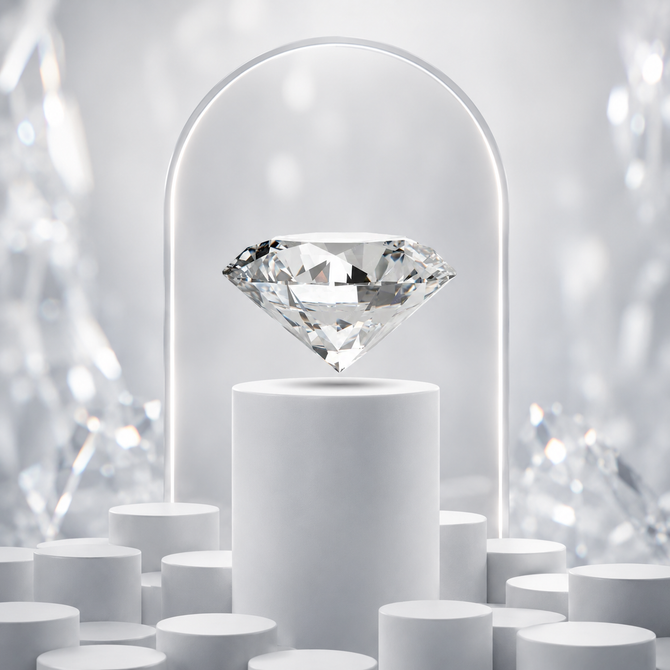
Caption: Ideal Scope handheld Viewer
Most Diamond Certificates Tell You a Grade. They cannot Show You This.
When you buy a diamond, you get a certificate. It tells you the cut grade, the color, the clarity, and the carat. Numbers and letters on a page. What it cannot tell you is how that diamond actually behaves when light hits it. Whether it returns that light back to your eye or lets it slip away. Whether the brilliance you see in the store holds up everywhere else.
That gap between what a certificate says and what a diamond actually does is where most buyers get surprised. And it is exactly the gap the Ideal Scope was built to close.
The Tool That Shows You What a Certificate Cannot
In the 1970s, a Japanese scientist named Okuda built one of the first tools that could actually show how a precision-cut lab-grown diamond performs in light. Not grade it. Show it. Garry Holloway later refined that idea into the Ideal Scope, a simple handheld tool with a red reflector inside.
The concept is straightforward. Place a diamond at the base of the tube, and light does one of three things.
- It returns correctly through the crown and appears red. This is what you want to see. The more red, the better the light performance the diamond is delivering.
- It leaks through the pavilion instead of coming back to your eye and appears white or gray. This is where a well-cut lab-grown diamond separates itself from one that just has a good grade on paper.
- It gets blocked by contrast zones and appears black. In a super ideal cut diamond, these black areas form a clean, symmetrical arrow pattern. That pattern is the visual signature of Hearts and Arrows optical symmetry, and it only appears when every facet is exactly where it should be.
Caption: Super Ideal Cut Diamond / Average Cut Diamond / Poorly Cut Diamond
What an Ideal Scope Image Tells You
Most people look at an Ideal Scope image for the first time and see a pattern. What they are actually looking at is a performance report that no certificate can replicate.
A precision-cut lab-grown diamond shows mostly red, very little white, and a sharp symmetrical black pattern. That combination tells you the diamond was cut with intention. Light goes in, returns correctly, and does exactly what a diamond is supposed to do.
An average cut shows scattered pink and patches of white. The pattern loses its sharpness. The diamond is performing below its potential, and most people who own one never know it because their certificate still says excellent.
A poorly cut diamond makes the problem impossible to ignore. Large white zones. Uneven patterning. Light leaves through the pavilion instead of returning to the eye. The grade on the paper means nothing at this point because the image tells a completely different story.
At Grown Diamonds, every precision-cut lab-grown diamond goes through Ideal Scope analysis before it reaches you. Not as a formality. As a standard. Because a diamond that cannot pass what the image shows is not a diamond we are willing to put our name on.
The Small White Edge You Will Notice
There is one thing that confuses people when they first look at an Ideal Scope image of even the finest lab-grown diamond. A thin, regular pattern of white leakage around the outer edge of the diamond.
It looks like a flaw. It is not.
This perimeter leakage is, in fact, a result of ideal cut proportions. It is built into the geometry of a super ideal cut diamond and plays a direct role in scintillation. That flash of light you see when a diamond moves. The sparkle that catches people off guard in an ordinary room under ordinary light.
Controlled perimeter leakage is not a sign that something went wrong in the cutting process. It is a sign that something went very right. It is one of the details that GCAL 8X certification captures and verifies, because at this level of precision, every detail matters and every detail can be proven.
This is one of those details that separates someone who truly understands diamond light performance from someone who is reading a number off a certificate. The image tells the full story. The certificate never could.
Caption: Controlled perimeter leakage in a super ideal cut diamond. This promotes positive contrast and scintillation
How We Image Every Diamond at GemCult
Smartphone photography introduces variables. Lighting changes. Angles shift. The result is an image that may look impressive but tells you nothing reliable about how the diamond truly performs.
At GemCult, every lab-grown diamond is photographed using a purpose-built standardized imaging system. A transparent tray, a controlled studio environment, and daylight-equivalent backlighting. Every single time, for every single diamond.
The goal is simple. What you see on the page should be exactly what the diamond delivers in real life. No flattering angles. No enhanced lighting. No gap between the image and the truth.
This matters more than most people realize. When you are choosing a precision-cut lab-grown diamond based on an Ideal Scope image, the quality of that image is everything. A poorly captured image can make an average diamond look exceptional and an exceptional diamond look ordinary.
We built our imaging process around one standard. Show the diamond exactly as it is. Because if a diamond is genuinely performing at the level we say it is, the image does not need any help.
Caption: Ideal Scope Photo Setup. GemCult Standardized Imaging System
ASET: When One Tool Is Not Enough
The Ideal Scope is one of the most honest tools in the diamond industry. But at GemCult, we do not stop there.
AGS Laboratories developed ASET, the Angular Spectrum Evaluation Tool, as the foundation of their advanced cut grading methodology. Where the Ideal Scope gives you a clear read on light return and leakage, ASET goes deeper. It maps brightness, contrast, and leakage with greater angular precision, showing not just whether light is returning but exactly where it is coming from and how much of it is reaching your eye.
Think of the Ideal Scope as the first conversation and ASET as the full picture.
ASET works as both a physical tool and a core part of AGS's computerized light performance grading system. It does not replace the Ideal Scope. It builds on it. Together, the two give a more complete and more honest evaluation of how a diamond performs than either one could deliver alone.
At GemCult, ASET analysis works alongside Ideal Scope imaging and GCAL 8X certification. Every certified lab-grown diamond we sell goes through all three. Not because we have to. Because a diamond performing at super ideal cut standards deserves to be proven at every level, not just one.
Caption: Light Performance Imagery for GemCult. Four Scientific Imaging Techniques Used to Evaluate Cut Quality
The Standard Every GemCult Is Held To
Most lab-grown diamond brands show you a certificate and ask you to trust it. At GemCult, we show you the certificate and the proof behind it.
Every precision-cut lab-grown diamond in our collection goes through Ideal Scope imaging, ASET analysis, and GCAL 8X certification before it is listed. Three separate tools. Three separate verifications. All are telling the same story about how that diamond performs in real light.
This is not a process we built for marketing. It is the process we built because we are the manufacturer. We grew the diamond. We cut it. We certified it. And we are the ones putting our name on it when it reaches you.
Most people never get to see this level of verification when they buy a diamond. They get a grade on a document and hope it translates into the brilliance they imagined. At GemCult, hope is not part of the process.
When you buy a certified lab-grown diamond from us, you are not buying a grade. You are buying a diamond that has been visually proven, at every level, to perform exactly the way a light performance diamond should.
That is the standard. And it applies to every single diamond we sell.


